
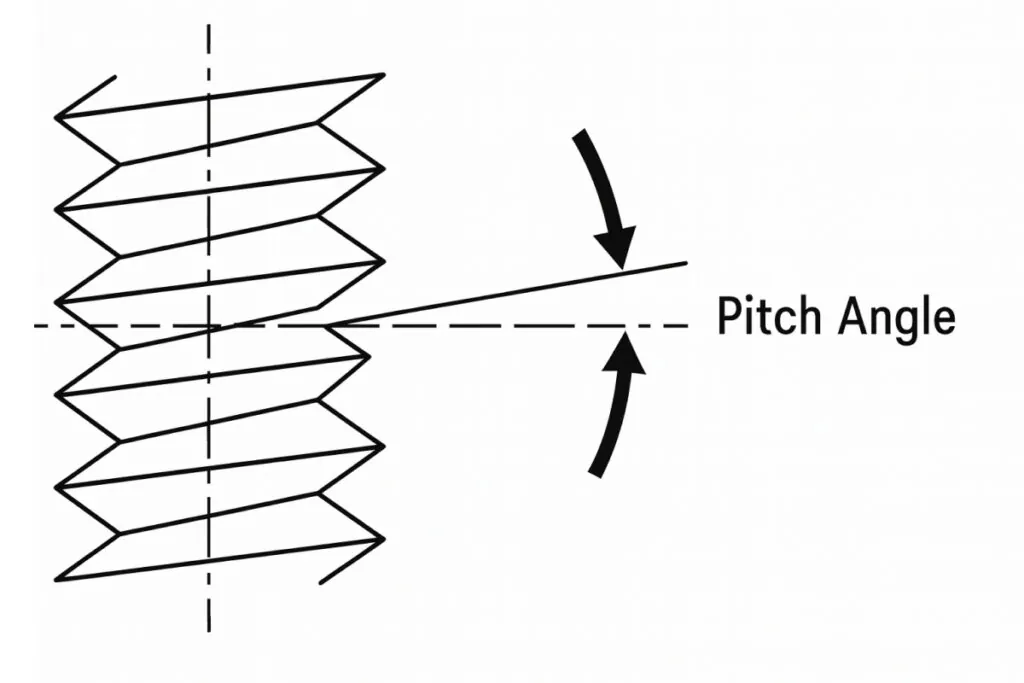
Pitch Angle

Diagram showing the pitch angle of a thread - Taiwan Screw Manufacturer

Definition of Pitch Angle

Pitch angle is the helix angle formed between a screw thread’s helical ridge and a plane that is perpendicular to the fastener’s central axis. Measured at the pitch diameter, it tells you how steeply the thread wraps around the shank. A larger pitch angle means the thread rises quickly, producing fewer threads per unit length, while a smaller angle yields a finer thread. Understanding pitch angle helps buyers and engineers predict how the fastener will behave in torque transmission, load distribution, and assembly speed within mechanical joints.

Why It Matters for Screws and Fasteners

A correctly specified pitch angle ensures you achieve the clamp load you designed for. If the angle is too steep, the joint may self-loosen under vibration because friction can no longer counteract axial forces. Conversely, an overly shallow angle can increase assembly time and raise the risk of galling.For manufacturers, pitch angle dictates the choice of thread-rolling dies, cutting speeds, and inspection gauges. Getting it right reduces tool wear and scrap, saving you both time and money.

FAQ

How is pitch angle measured on a screw?

Measure the lead or pitch of the thread, calculate the helix rise per revolution, then use trigonometry to find the angle at the pitch diameter. Many thread-inspection systems output it automatically.

Is pitch angle the same as thread lead angle?

They describe the same geometry but at different points. Lead angle is taken at the major diameter, while pitch angle is taken at the pitch diameter for better accuracy.

Does a higher pitch angle always mean faster assembly?

Generally yes, because fewer turns seat the fastener. However, torque control becomes harder and vibration resistance drops, so balance speed with joint integrity.

inquire now