
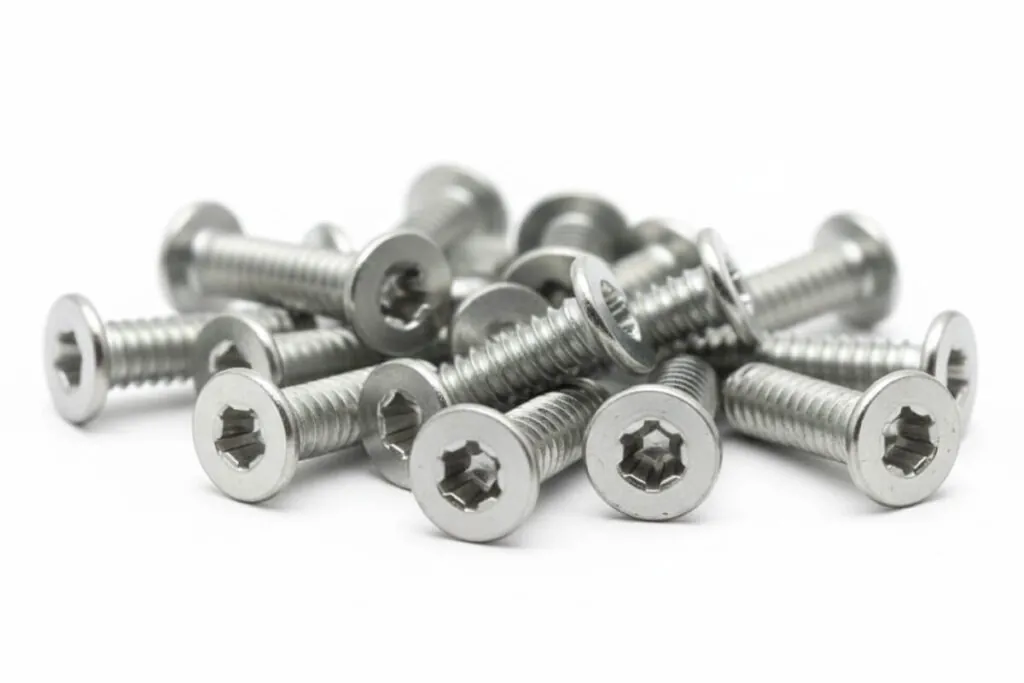
Flat Head Machine Screws

This image shows a group of flat head machine screws on a white background - Taiwan Screw

Definition of Flat Head Machine Screws

Flat head machine screws are precision-threaded fasteners with a countersunk head designed to sit flush with or below the surface of the material being fastened. The head features a flat top and angled underside, typically at 82 degrees for metric standards or 100 degrees for some imperial applications. These screws require pre-drilled and countersunk holes and are tightened using Phillips, slotted, Torx, or hex socket drives. Flat head machine screws are manufactured to tight tolerances and work with pre-tapped holes or nuts. They are commonly used in electronics, machinery, metal fabrication, and furniture where a smooth, flush surface is essential for aesthetics, safety, or function. The countersunk design prevents snagging and creates a professional finish while maintaining strong mechanical connections in metal, plastic, and composite assemblies.

Why It Matters for Screws and Fasteners

When you specify flat head machine screws, you gain a clean surface profile that eliminates protrusions. This matters in applications where moving parts, sliding components, or human contact make raised fasteners a liability. The flush installation reduces wear on adjacent surfaces and prevents clothing, cables, or tools from catching on screw heads during operation or maintenance.

The countersunk design also distributes clamping force differently than pan or button head screws. You must ensure your material thickness and countersink depth provide adequate bearing surface to prevent the head from pulling through under load. In softer materials like aluminum or plastic, you may need larger head diameters or reinforcing washers beneath the surface to maintain joint integrity over time.

Quality flat head machine screws from Taiwan manufacturers meet ISO or DIN standards for head angle, thread pitch, and dimensional accuracy. This consistency allows you to use the same countersink tools and assembly processes across production runs, reducing setup time and quality variations in your manufacturing line.

FAQ

What is the difference between flat head machine screws and flat head wood screws?

lat head machine screws have uniform threads along the entire shank and require pre-tapped holes or nuts. Wood screws have tapered shanks with coarser threads designed to cut into wood fibers without pre-drilling tapped holes.
Machine screws offer precise, repeatable torque specifications for metal and engineered materials, while wood screws rely on thread engagement in softer substrates. Always match the screw type to your material and load requirements.

What countersink angle should I use for flat head machine screws?

Most metric flat head machine screws use an 82-degree countersink angle as specified in ISO 7046 and ISO 2009 standards. Some imperial and older standards use 100-degree angles. Check your screw specifications before drilling countersinks.
Using the wrong angle creates poor head seating, reduces clamping force, and can damage the screw head during installation. Quality countersink tools are marked with their angle for easy identification.

Can flat head machine screws be used in materials that cannot be countersunk?

No, flat head machine screws require countersunk holes to function properly. If your material is too thin or too brittle for countersinking, use pan head, button head, or truss head machine screws instead. These alternatives provide surface bearing without requiring material removal.
Attempting to install flat head screws without proper countersinks will damage the material, prevent flush installation, and compromise joint strength.

inquire now