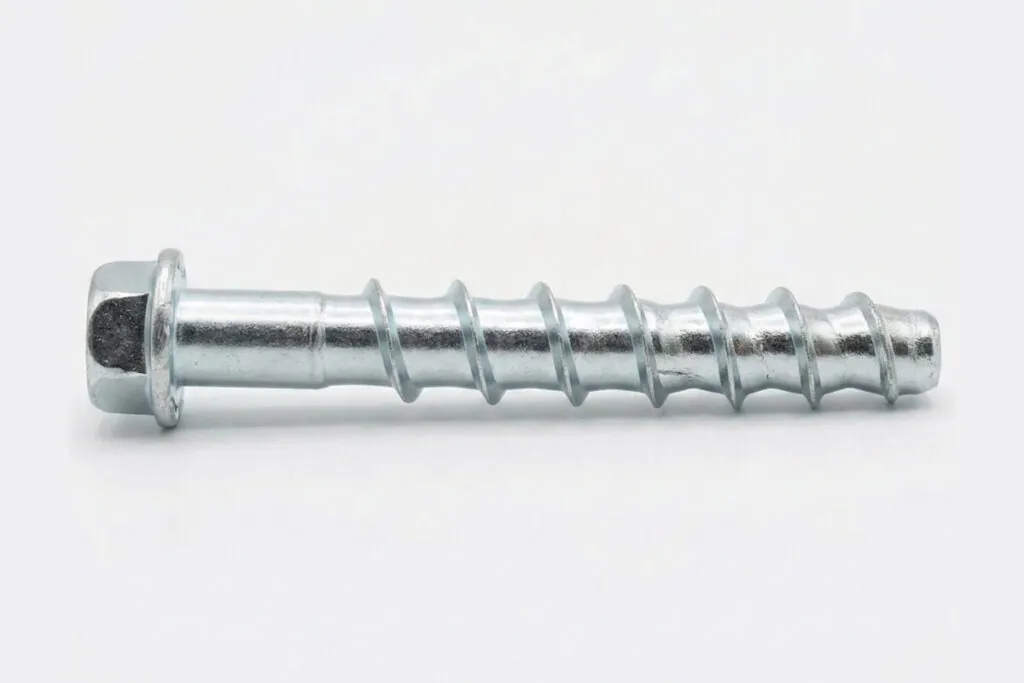
Concrete Anchor Screws

This image shows a concrete anchor screw on a white background

Definition of Concrete Anchor Screws

Concrete anchor screws are construction fasteners designed to thread directly into pre-drilled holes in concrete, brick, or masonry without requiring a separate anchor insert. The hi-lo thread profile or twin-lead thread geometry cuts into the substrate material as the screw is driven, creating a mechanical interlock that resists both tensile pullout and shear loads.

Proper embedment depth, hole diameter tolerance, and screw diameter are critical variables that determine the load capacity of each installation. Common applications include attaching framing, mechanical equipment supports, conduit hangers, and curtain wall anchors to concrete or CMU substrates in commercial construction.

Why It Matters for Screws and Fasteners

Thread Design and Load Transfer
The thread design of concrete anchor screws as construction fasteners determines how load transfers from the fastener to the substrate. Coarse, hardened threads with sharp crests cut cleanly into concrete without pre-cracking the surrounding material, maintaining bearing area around each thread helix. Thread pitch and lead angle must be matched to the concrete density and hole diameter to achieve consistent installation torque and predictable pullout resistance.

Embedment Depth and Safety Factors
Minimum embedment depth for concrete anchor screws is typically specified at 1 inch or 25 mm, though structural applications require engineering calculations based on base material compressive strength and the applied load combination. Shallow embedment significantly reduces allowable tension and shear values and is a common source of field failures. Engineers specifying construction fasteners for concrete must verify that screw length provides adequate embedment after accounting for fixture thickness.

Coating and Corrosion Resistance
Concrete has a high pH environment that can accelerate corrosion on unprotected carbon steel concrete anchor screws. Hot-dip galvanizing, mechanical zinc plating, or stainless steel grades 304 and 316 are standard specifications for exterior and moisture-exposed applications. Coating selection must also consider compatibility with chemical contact from admixtures or cleaning agents used at the site.

FAQ

What hole diameter and embedment depth are required for concrete anchor screws used in structural construction fasteners applications to achieve rated load capacity?

Achieving rated load capacity with concrete anchor screws in structural construction fasteners applications requires strict adherence to the manufacturer's published installation specifications. Hole diameter is typically screw-diameter specific, often 3/16 in. or 1/4 in. for the corresponding screw size, and must be drilled with a carbide bit to maintain tolerance within +0/-0.005 in. Embedment depth must meet the minimum specified in ICC-ES or ETA approval documents, usually ranging from 1 to 3 inches depending on load requirements. Manufacturers like Cheng Hao provide installation datasheets that include torque ranges and substrate strength requirements for each concrete anchor screw model.

Which coating specification is most suitable for concrete anchor screws used as construction fasteners in exterior or wet-area installations?

For exterior or wet-area construction fasteners applications, concrete anchor screws should be specified in 316 stainless steel for direct marine or chloride exposure, or hot-dip galvanized to ASTM A153 for general exterior use. Mechanical zinc plating provides adequate protection in dry interior conditions but is insufficient where condensation or direct water contact occurs. Yellow zinc chromate offers marginal improvement over clear zinc and is typically limited to protected interior applications. Always verify that the coating specification matches the exposure category defined in the project's corrosion protection schedule to avoid premature degradation of the anchor connection.

How should concrete anchor screws be torque-tested on-site to confirm construction fasteners installation meets design load requirements?

On-site torque verification for concrete anchor screws as construction fasteners typically involves applying a proof torque value, specified as a percentage of the installation torque, after the screw reaches full embedment. If the fastener rotates under proof torque, the installation is rejected and the hole must be relocated. Some specifications require direct tension testing using a calibrated pull-out fixture that applies load axially to confirm minimum embedment resistance. The testing frequency should be defined in the project quality plan, with minimum sampling rates per ICC-ES AC193 or the relevant European technical assessment document for the specific concrete anchor screw product.

inquire now