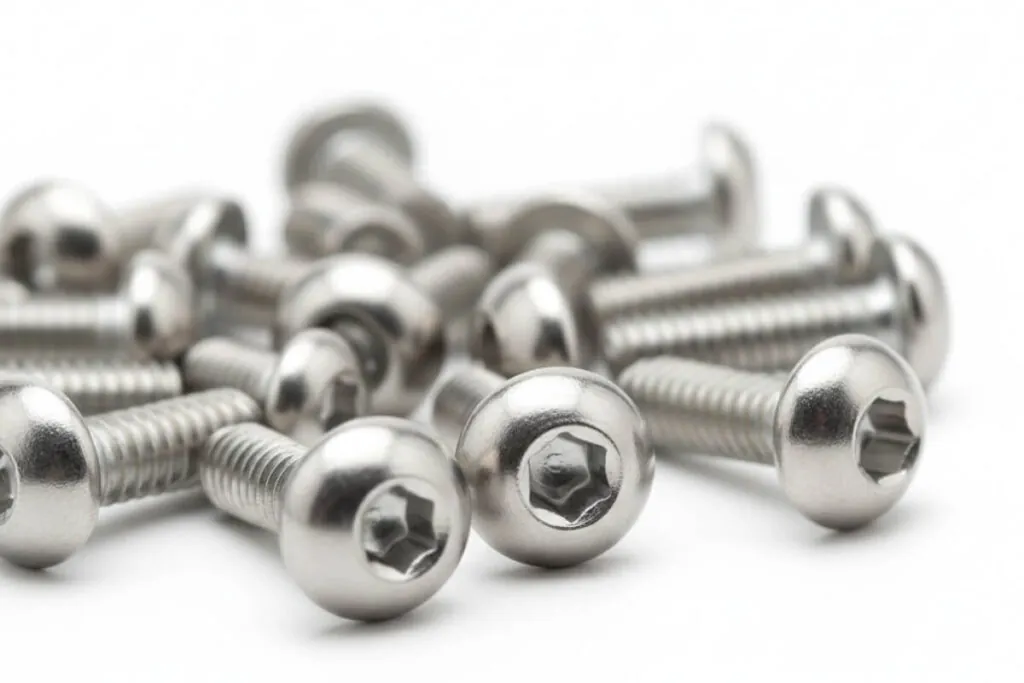
Button Head Socket Screws

This image shows a group of buton head socket screws on a white background, Taiwan Screw

Definition of Button Head Socket Screws

Button head socket screws are precision fasteners with a low-profile, dome-shaped head and a hexagonal socket drive. The head has a wider diameter and lower height compared to standard socket head cap screws, creating a large bearing surface while minimizing protrusion above the workpiece. These screws are manufactured to ISO 7380 standards and feature a rounded top that provides a smooth, finished appearance.

The hex socket drive allows high torque transmission and works well in recessed or countersunk applications. Button head socket screws are commonly used in machinery, automotive components, sporting equipment, and consumer products where aesthetics, safety, and space constraints are important. They distribute clamping load over a wider area than traditional cap screws, making them suitable for softer materials or applications requiring reduced surface stress concentrations.

Why It Matters for Screws and Fasteners

When you select button head socket screws, you balance strength with a low visual profile. The wider head diameter spreads clamping force across more surface area, reducing the risk of material deformation or pull-through in aluminum, plastic, or thin sheet metal assemblies. This makes them particularly valuable when you cannot use washers or when the application requires a clean, streamlined appearance.

The rounded head design also improves safety in consumer-facing products. Unlike hex head or socket head cap screws with sharp edges, button heads minimize snagging hazards and provide a more comfortable tactile experience. This matters in sporting goods, furniture, bicycle components, and any product where human contact with fasteners is likely during normal use or maintenance. In automated assembly environments, button head socket screws offer consistent tool engagement and reliable torque transfer. The hex socket resists cam-out better than Phillips or slotted drives, allowing you to use power tools without frequent bit replacement. Taiwan manufacturers produce these screws in stainless steel, alloy steel, and other materials with tight tolerances that ensure dimensional consistency across production runs.

FAQ

What is the main difference between button head socket screws and socket head cap screws?

Button head socket screws have a wider, lower-profile head with a rounded top, while socket head cap screws feature a taller, cylindrical head with a smaller diameter. Button heads typically protrude 50-60% less above the surface and distribute load over a larger area.
Socket head cap screws provide higher tensile strength and are preferred for high-stress structural applications. Choose button heads when aesthetics and low profile matter more than maximum strength.

Can button head socket screws be used in applications requiring flush mounting?

Button head socket screws are not designed for flush mounting since they protrude above the surface. If you need a flush finish, use flat head machine screws with proper countersinking. However, button heads can be installed in shallow counterbores to reduce protrusion while maintaining most of their bearing surface area. This approach works well when you want a low profile without completely flush installation.

What materials are button head socket screws typically available in?

Taiwan manufacturers commonly produce button head socket screws in stainless steel grades like 304 and 316 for corrosion resistance, alloy steel grades like 12.9 and 10.9 for high strength applications, and carbon steel with various coatings including zinc plating and black oxide.
Stainless steel versions are popular in food equipment, marine applications, and outdoor products. Alloy steel variants suit automotive and machinery applications requiring high clamping forces.

inquire now