
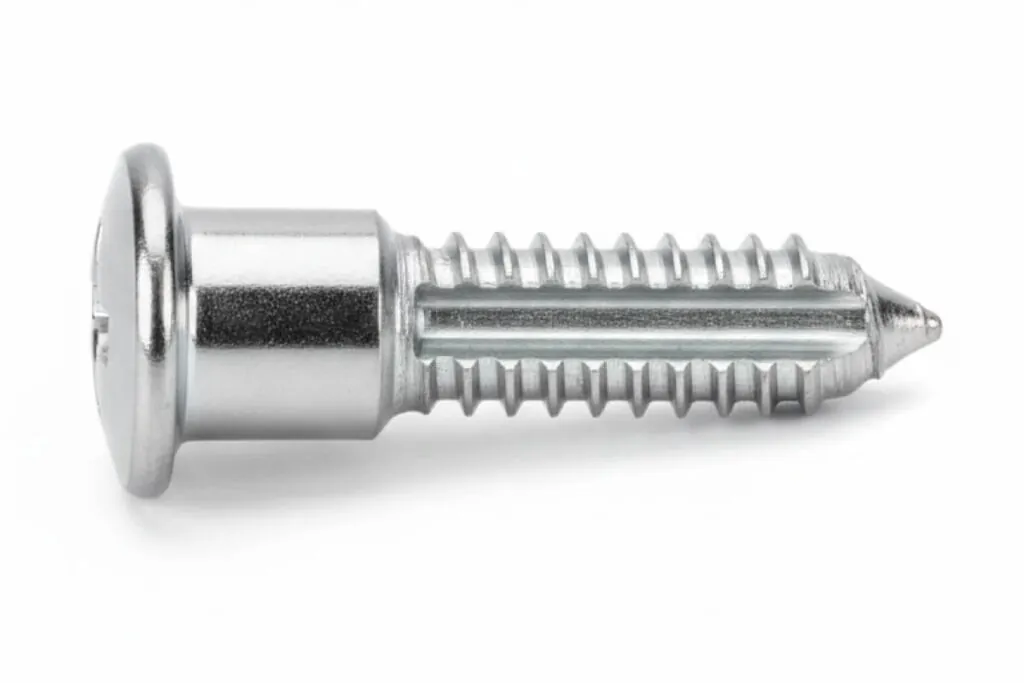
The reduced head diameter in precision fasteners undercut flat head screws decreases the bearing area available to resist pull-through forces, requiring careful engineering analysis for thin-gauge applications. Standard flat head screws distribute pull-through loads across the full countersink diameter, while undercut heads concentrate these forces on the smaller cylindrical bearing surface beneath the taper. For 18-gauge steel (0.048 inches), an undercut flat head may reduce pull-through capacity by 25 to 35 percent compared to standard heads. When sourcing from manufacturers like Cheng Hao, engineers must calculate the effective bearing stress by dividing the applied tensile load by the undercut head's bearing area, then comparing this value against the material's bearing strength to ensure adequate safety factors. Applications requiring maximum pull-through resistance may necessitate larger fastener diameters or the use of backing washers to distribute loads, though these solutions must be balanced against the space constraints that originally motivated the undercut head selection.
Countersink angle tolerances for precision fasteners undercut flat head screws typically range from ±2 degrees for general applications to ±1 degree for precision assemblies requiring repeatable flush seating. The standard 82-degree countersink angle provides compatibility with most countersink tooling, while 90-degree variants offer slightly larger bearing surfaces for applications where pull-through resistance is marginal. Cheng Hao recommends verifying that the fastener's countersink angle matches the prepared hole angle within one degree to prevent incomplete seating or excessive head protrusion. In automated assembly environments, consistent countersink angles ensure uniform seating depth when robots apply position-controlled driving rather than torque-controlled, preventing quality issues from angle mismatches that cause some fasteners to sit proud while others over-compress the base material. The undercut geometry amplifies the sensitivity to angle deviations, as the reduced bearing diameter provides less tolerance for angular misalignment between fastener and countersink surfaces.
The reduced head height of precision fasteners undercut flat head screws necessitates careful optimization of drive recess depth to maintain adequate torque transmission capacity. Since the undercut geometry reduces overall head volume, the drive socket must be proportionally shallower to preserve sufficient material thickness between the recess floor and the head's underside for structural integrity. Manufacturers typically reduce socket depth by 15 to 25 percent compared to standard flat head screws of equivalent diameter, requiring verification that driver bits maintain adequate engagement for installation torque requirements. Excessively deep sockets risk breakthrough or deformation of the thin head section during high-torque installation, particularly in hardened fasteners where material ductility is limited. The socket design must balance torque capacity against the geometrical constraints imposed by the undercut head profile, with quality control procedures verifying that production batches maintain consistent depth tolerances to prevent assembly failures from inadequate driver engagement or premature socket stripping in field service conditions.

| Service | Cookies | Description |
|---|---|---|
| Google Analytics | _gat_gtag, _ga, _gid | Used to distinguish users and sessions for web statistics purposes. |
| Service | Cookies | Description | |
|---|---|---|---|
| Google Analytics | _gat_gtag, _ga, _gid | Used to distinguish users and sessions for web statistics purposes. |