
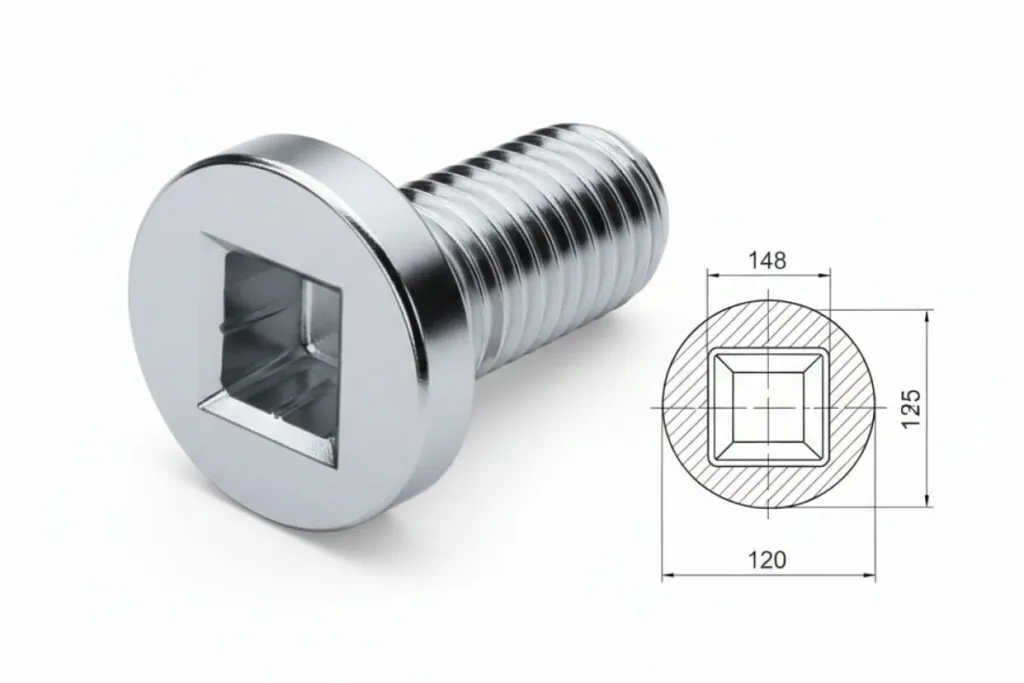
Custom screw manufacturers square drive screws and star drive (Torx) systems both provide superior torque transfer compared to Phillips drives, but each offers distinct advantages for specific construction applications. Square drives excel in applications requiring one-handed installation and rapid bit engagement, as the square geometry naturally centers and holds the fastener on the driver bit. Star drives deliver marginally higher torque capacity due to six contact points versus four, making them preferable for extremely dense materials or impact driver applications. When sourcing from manufacturers like Cheng Hao, construction contractors often select square drive screws for deck building and framing applications where installation speed and bit retention outweigh the incremental torque advantage of star drives, particularly when using pneumatic or battery-powered tools in repetitive fastening operations.
Socket depth specifications for custom screw manufacturers square drive screws must accommodate standard driver bit dimensions while providing sufficient engagement for torque transmission. Industry standard square drive sockets maintain depths between 0.120 to 0.180 inches for #2 size and 0.150 to 0.220 inches for #3 size, with these measurements ensuring full bit seating without bottoming out against the socket floor. Cheng Hao maintains strict tolerances on socket depth to prevent bit interference while maximizing the engaged surface area between driver flats and socket walls. Shallow sockets reduce torque capacity and increase cam-out risk, while excessively deep sockets may not fully engage shorter bits or those with worn tips. Distributors should verify that socket depth coordinates with head height, as countersunk heads require deeper sockets to maintain adequate drive engagement when the fastener is flush-mounted, particularly critical for finish carpentry and cabinetry applications where complete head embedment is mandatory.
The self-centering and bit-retention characteristics of custom screw manufacturers square drive screws provide significant advantages in automated assembly operations. The square geometry naturally aligns the driver bit with the socket centerline, reducing positioning errors that cause assembly faults or damage to automated tooling. Unlike Phillips or slotted drives that require precise angular alignment and constant downward pressure, square drives grip the bit securely through friction and geometric interference, allowing robotic pick-and-place systems to transfer fasteners reliably without supplemental holding mechanisms. This capability reduces cycle times and improves first-pass yield rates in high-volume manufacturing. The absence of cam-out behavior eliminates a common failure mode in automated fastening, where inconsistent torque application causes bit ejection and process interruptions. Manufacturing environments utilizing square drive screws in product assembly experience fewer bit replacements and reduced downtime for tooling adjustments compared to facilities relying on traditional drive configurations.

| Service | Cookies | Description |
|---|---|---|
| Google Analytics | _gat_gtag, _ga, _gid | Used to distinguish users and sessions for web statistics purposes. |
| Service | Cookies | Description | |
|---|---|---|---|
| Google Analytics | _gat_gtag, _ga, _gid | Used to distinguish users and sessions for web statistics purposes. |