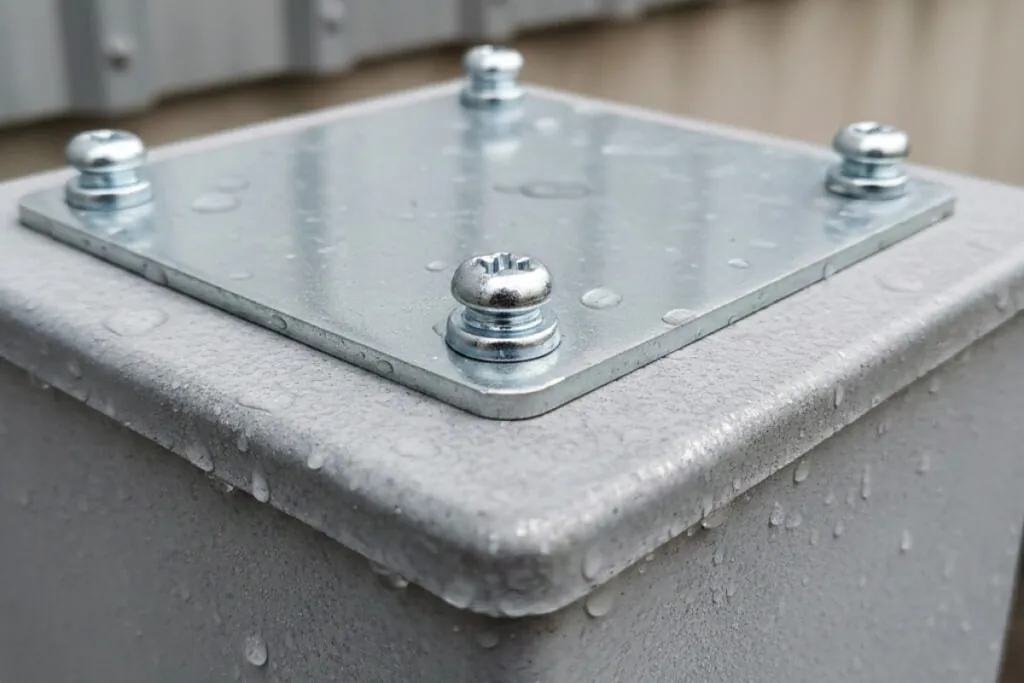
High Corrosion Resistance Screws

This image shows high corrosion resistance screws installed in the cover of an outlet on a roor

Definition of High Corrosion Resistance Screws

High corrosion resistance screws are fasteners engineered through advanced material selection, surface treatments, or protective coatings to prevent oxidation and degradation in chemically aggressive or moisture-laden environments. Custom screw manufacturers high corrosion resistance screws typically employ stainless steel alloys (304, 316, 410), zinc-nickel coatings, ceramic composites, or proprietary polymer systems to create barriers against electrochemical corrosion processes.

The designation "high corrosion resistance" indicates performance exceeding standard zinc-plated fasteners, typically measured through salt spray testing per ASTM B117 where qualified screws survive 500-1000+ hours without red rust formation. These fasteners serve critical applications in coastal construction, chemical processing, water treatment, HVAC systems, and outdoor infrastructure where standard fasteners would fail within months. Material and coating selection depends on specific corrosive agents, with stainless steel optimal for oxidizing environments and specialized coatings preferred for alkaline or acidic exposure.

Why It Matters for Screws and Fasteners

Corrosion represents the leading cause of fastener failure in industrial and construction applications, with economic costs exceeding billions annually in replacement and structural damage. High corrosion resistance screws prevent this degradation through multiple protection mechanisms: barrier coatings isolate base metal from corrosive media, sacrificial coatings provide cathodic protection, and passive oxide layers in stainless steels self-heal minor damage. Selection of appropriate corrosion protection determines whether fasteners survive years or decades in service.

In chemical processing and water treatment facilities, custom screw manufacturers high corrosion resistance screws must resist specific pH ranges and chemical compositions. Stainless steel grades are selected based on chloride content, temperature, and oxidizing conditions, with 316-grade materials required for chloride concentrations exceeding 1000 ppm. Coating technologies like zinc-nickel alloys or ceramic composites extend protection to carbon steel substrates, offering cost advantages over solid stainless construction.

Performance verification requires standardized testing and documentation. Manufacturers must provide salt spray test results, material certifications, and application-specific corrosion data. Installation practices also affect corrosion resistance, as thread damage or coating breakthrough during driving can create initiation sites for accelerated degradation, necessitating proper torque control and compatible driving bits.

FAQ

What coating provides the longest rust protection for outdoor screws?

For maximum rust protection on outdoor screws, stainless steel construction (particularly 316-grade) provides the longest service life, lasting 25-30+ years in most environments without coating degradation. When cost constraints require coated carbon steel, custom screw manufacturers high corrosion resistance screws with zinc-nickel alloy coatings (12-15% nickel) offer superior performance, surviving 1000+ hours in ASTM B117 salt spray testing compared to 200-300 hours for standard zinc. Cheng Hao produces zinc-nickel coated screws that outperform hot-dip galvanized fasteners by 3-5 times in accelerated corrosion testing. For extreme chemical exposure, ceramic-epoxy composite coatings resist both oxidation and chemical attack. Coating thickness significantly impacts protection duration: specify minimum 8-12 microns for zinc-nickel coatings and 40-60 microns for ceramic systems to ensure adequate barrier protection.

How do different stainless steel grades compare for corrosion resistance in screws?

Stainless steel grades for custom screw manufacturers high corrosion resistance screws rank by corrosion protection: 316/316L (marine environments, chemical exposure), 304/304L (general outdoor use, food processing), 410 (mild environments, higher strength applications). Type 316 contains molybdenum for chloride resistance, surviving coastal and chemical environments where 304 would pit within months. Type 304 provides excellent resistance to atmospheric corrosion and most organic compounds but fails rapidly in chloride-rich conditions. Martensitic 410 stainless offers higher strength and wear resistance but lower corrosion protection than austenitic grades. Manufacturers such as Cheng Hao can specify appropriate grades based on environment: 316 for coastal areas, chemical plants, and marine applications; 304 for general construction and food service; 410 for applications prioritizing strength over maximum corrosion resistance.

What testing standards verify high corrosion resistance in screws?

ASTM B117 neutral salt spray testing represents the primary standard for verifying corrosion resistance in custom screw manufacturers high corrosion resistance screws, measuring time-to-red-rust in 5% sodium chloride fog at 35°C. High-performance screws survive 500-1000+ hours versus 96-200 hours for standard zinc plating. ASTM G85 Annex 5 provides accelerated cyclic testing simulating coastal environments through alternating wet/dry cycles. ISO 9227 offers international standards equivalent to ASTM B117. For specific chemical resistance, ASTM G31 guides immersion testing in relevant media. Real-world performance often differs from accelerated testing, so manufacturers should provide field exposure data from actual installations in addition to laboratory results, demonstrating proven performance in end-use environments.

inquire now