
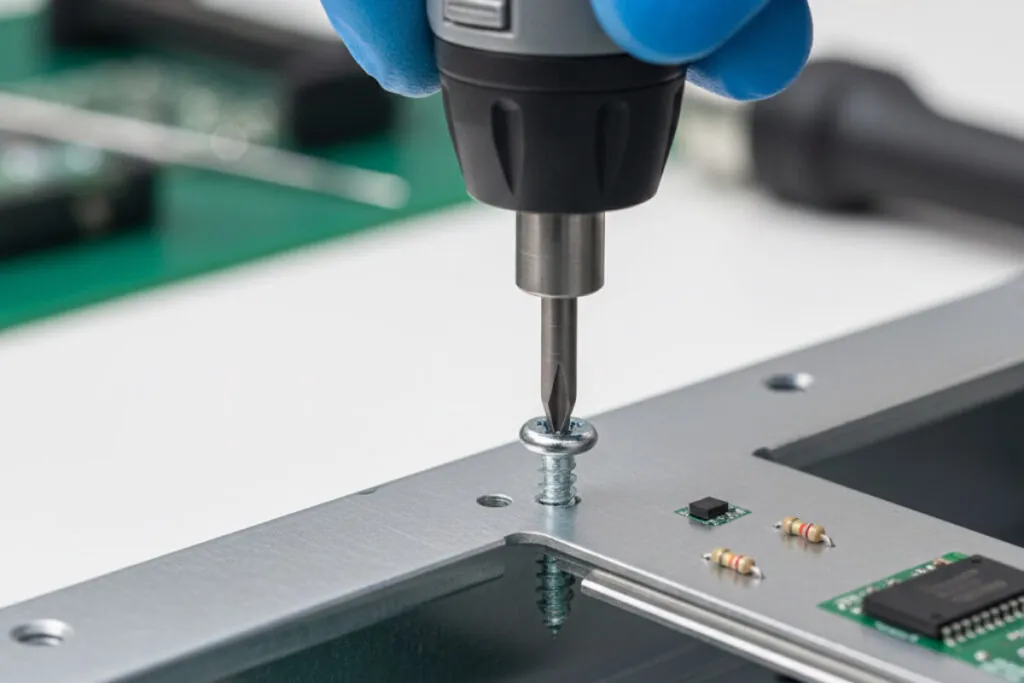
Thread-forming construction fasteners sheet metal screws create threads by displacing aluminum material through plastic deformation, while thread-cutting screws remove material via cutting edges, producing fundamentally different performance characteristics in HVAC ductwork. Thread-forming screws generate higher clamp loads and improved vibration resistance through interference fits created by work-hardened aluminum, making them preferable for connections experiencing airflow-induced vibration or thermal expansion cycling. However, forming requires greater installation torque and may cause material splitting in hard-temper aluminum or near sheet edges where material constraint prevents adequate deformation. Thread-cutting screws produce lower installation torques and eliminate splitting risks but generate aluminum chips that can contaminate ductwork interiors and reduce thread engagement strength compared to formed threads. When sourcing from manufacturers like Cheng Hao, HVAC contractors typically specify thread-forming screws for structural connections in spiral duct systems where vibration resistance justifies higher installation forces, while thread-cutting variants suit access panel attachment or applications in brittle aluminum alloys where material cracking concerns outweigh the performance advantages of formed threads.
Pilot hole diameter selection for construction fasteners sheet metal screws in 20-gauge galvanized steel (0.036 inches thickness) depends on screw type and material ductility. For thread-forming Type AB screws in sizes #8 to #12, pilot holes should approximate 75 to 85 percent of the screw's major diameter, providing sufficient material for thread formation while preventing excessive installation torque that risks screw head twisting-off or drive recess stripping. A #10 screw (0.190 inch major diameter) typically requires a 0.140 to 0.161 inch pilot hole (#26 to #20 drill). Cheng Hao recommends verifying pilot hole sizing through installation trials, as galvanized coatings add 0.001 to 0.003 inches of material thickness that affects thread engagement. Self-drilling sheet metal screws eliminate pilot hole requirements for materials through 0.060 inches but demand drill point quality verification, as worn or damaged points cause oval holes reducing clamp load consistency. Undersized pilots increase installation torque and material distortion, while oversized holes reduce thread engagement length below minimum requirements, typically 1.5 times the nominal diameter for adequate shear and pullout resistance in thin-gauge steel applications.
Hex washer heads on construction fasteners sheet metal screws integrate a hexagonal drive with an enlarged bearing surface, providing multiple functional advantages for outdoor HVAC applications. The hex configuration enables installation with standard nut drivers or sockets, delivering higher torque transmission than Phillips or slotted drives while allowing rapid tool engagement critical for high-volume assembly operations. The integral washer increases bearing area by 200 to 300 percent compared to pan heads, distributing clamp loads across larger surface areas that prevent dimpling or tearing of thin sheet metal under installation torque. This becomes essential for equipment subjected to wind loading or vibration where overtightened pan head screws may pull through the base material. The washer component also seals against gaskets or weatherproof membranes more effectively than small-diameter heads, improving moisture resistance at penetrations through equipment panels. Outdoor installations benefit from the hex washer head's visibility during maintenance inspections, as the larger profile simplifies fastener counting to verify panel security, while the bright zinc or stainless finish contrasts visually against darker equipment surfaces, enabling quick identification of loose or missing fasteners during routine service visits.

| Service | Cookies | Description |
|---|---|---|
| Google Analytics | _gat_gtag, _ga, _gid | Used to distinguish users and sessions for web statistics purposes. |
| Service | Cookies | Description | |
|---|---|---|---|
| Google Analytics | _gat_gtag, _ga, _gid | Used to distinguish users and sessions for web statistics purposes. |