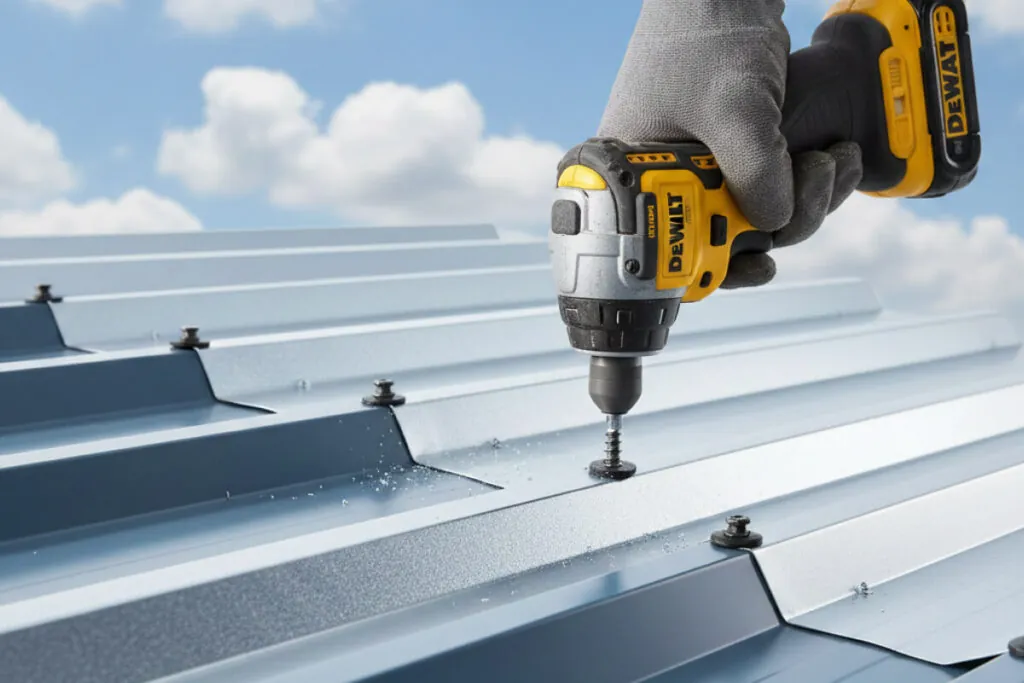
Metal Roofing Screws

This image shows metal roofing screws installed in a roof

Definition of Metal Roofing Screws

Metal roofing screws are specialized construction fasteners designed for attaching metal panels to wood or steel purlins in roofing applications, featuring self-drilling points that penetrate steel substrates without pre-drilling, integrated EPDM or neoprene sealing washers for weatherproof installation, and corrosion-resistant coatings matched to panel materials. Construction fasteners metal roofing screws typically employ #12 to #14 diameter shanks for adequate pull-through resistance, hex washer heads for tool engagement and load distribution, and lengths from 3/4 inch to 6 inches depending on substrate type and insulation thickness.

The self-drilling point, classified as Type 3 for 1/4-inch steel penetration or Type 5 for thicker substrates, eliminates pre-drilling while the bonded washer compresses to create a weather seal. High-quality metal roofing screws incorporate bi-metal construction or stainless steel in coastal environments to prevent galvanic corrosion when paired with aluminum or Galvalume panels.

Why It Matters for Screws and Fasteners

Metal roofing screws must perform three critical functions simultaneously: penetrate substrates without pre-drilling, create weathertight seals, and resist corrosion for 30-50 year service life matching panel warranties. Failure in any function leads to roof leaks, panel blow-off, or premature replacement. The integrated EPDM washer provides the critical weather seal, but only when screw installation achieves proper compression without over-tightening that crushes the washer or under-tightening that leaves gaps.

Self-drilling point geometry in construction fasteners metal roofing screws determines installation success and tool life. Type 3 points (drilling 1/4-inch steel) suit most residential applications, while commercial installations over heavier steel purlins require Type 5 points. Point hardness must exceed substrate hardness by 10-15 Rockwell points to prevent point deformation, yet the screw body requires sufficient ductility to avoid brittle fracture during driving. Heat treatment must balance these competing requirements.

Corrosion compatibility between fasteners and panels prevents galvanic corrosion that destroys both materials. Aluminum panels require aluminum or stainless steel screws; Galvalume panels accept zinc-coated screws; copper panels mandate copper or stainless fasteners. Coating color matching maintains aesthetic appearance while UV-resistant coatings prevent chalking and degradation over decades of sun exposure.

FAQ

Which screws work best for fastening metal roofing panels?

For fastening metal roofing panels, use #12 x 1-inch construction fasteners metal roofing screws with Type 3 self-drilling points for wood substrates or #12 x 7/8-inch screws with Type 3 points for steel purlins up to 1/4-inch thickness. Specify hex washer heads with bonded EPDM washers providing 1-inch diameter sealing area. When sourcing from manufacturers like Cheng Hao, request screws with corrosion-resistant coatings compatible with your panel material: zinc-coated for steel panels, aluminum or stainless for aluminum panels, stainless for copper or coastal applications. For commercial installations over thicker steel substrates, upgrade to Type 5 points capable of drilling 1/2-inch steel. Verify that washers meet ASTM D1056 specifications for ozone and UV resistance, ensuring the weather seal survives 20-30 years of exposure.

How do EPDM washers on metal roofing screws prevent leaks?

EPDM (ethylene propylene diene monomer) washers on construction fasteners metal roofing screws create weathertight seals through controlled compression between the screw head and roof panel surface. During installation, proper torque compresses the EPDM washer from its original 3-4mm thickness to approximately 1.5-2mm, causing the elastomer to flow and conform to panel contours while maintaining recovery force against the head. The washer must compress sufficiently to seal surface irregularities yet retain enough thickness to maintain sealing pressure through thermal cycling and panel expansion. Cheng Hao manufactures metal roofing screws with bonded EPDM washers meeting ASTM D1056 grade 2A1 specifications, providing resistance to ozone, UV radiation, and temperature extremes from -40°F to 300°F, with projected service life exceeding 25 years when properly installed.

What point type should I specify for different substrate thicknesses in metal roofing?

Point type selection for construction fasteners metal roofing screws depends on maximum steel substrate thickness: Type 2 points drill up to 1/8-inch steel (16-18 gauge), Type 3 points drill 1/4-inch steel (12-14 gauge), Type 4 points drill 3/8-inch steel, and Type 5 points drill 1/2-inch steel. For wood substrates, Type 17 points provide optimal performance. Most residential metal roofing uses Type 3 points over wood or light-gauge steel purlins. Commercial applications with heavier structural steel require Type 4 or Type 5 points. Using insufficient point capacity causes point deformation, wallowed holes, and installation failures, while oversized points waste cost and may split wood substrates. Specify point type based on the thickest substrate the screw will penetrate, ensuring reliable drilling performance without pre-punching or excessive tool wear.

inquire now