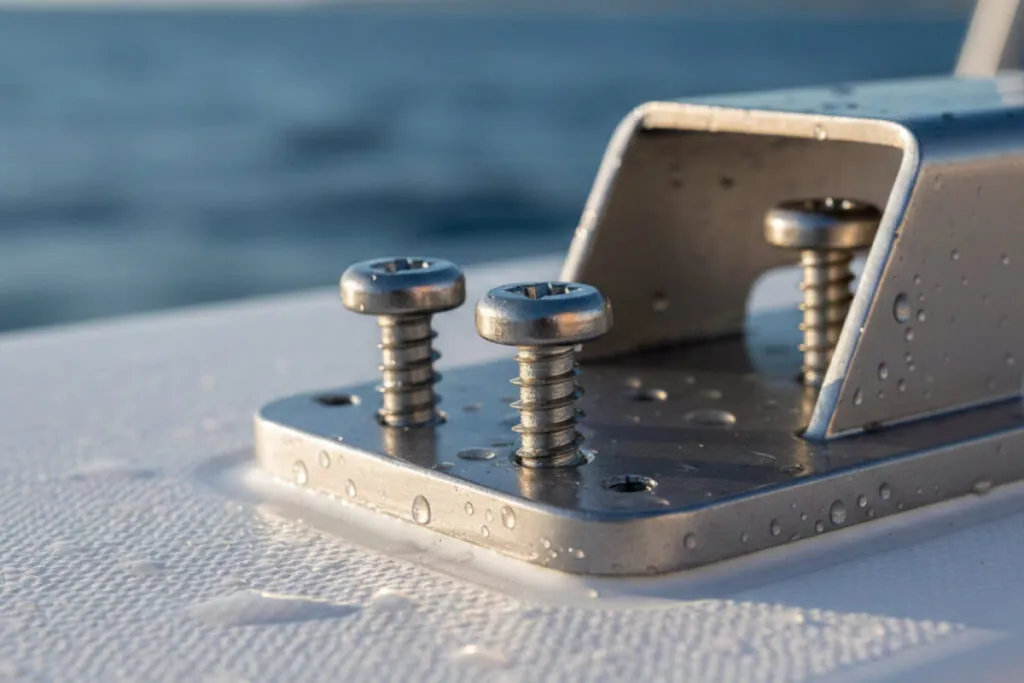
For coastal marine environments, Type 316 or 316L stainless steel provides optimal performance for construction fasteners marine grade stainless steel screws applications. The 316 grade contains 16-18% chromium, 10-14% nickel, and critically, 2-3% molybdenum, which creates superior resistance to chloride pitting and crevice corrosion compared to standard 304 stainless. When sourcing from manufacturers like Cheng Hao, verify that material certifications confirm true 316-grade composition, as mislabeled fasteners represent a common quality issue in marine applications. For extreme service conditions including submersion or direct saltwater spray, specify 316L (low carbon) to prevent sensitization during welding or high-temperature exposure, ensuring maximum corrosion resistance throughout the fastener lifecycle.
Marine grade stainless steel screws outperform standard 304 stainless fasteners through molybdenum-enhanced corrosion resistance, critical for construction fasteners marine grade stainless steel screws exposed to chloride environments. While 304 stainless may show surface corrosion within months of coastal exposure, 316 marine grade maintains integrity for 20-30 years in the same conditions. The molybdenum content (absent in 304) stabilizes the passive oxide film against chloride attack, preventing the pitting corrosion that initiates fastener failure. Manufacturers such as Cheng Hao produce marine grade screws meeting ISO 3506-1 Grade A4 specifications, providing documented salt spray resistance exceeding 1000 hours per ASTM B117 testing, compared to 200-300 hours typical for standard stainless grades.
Marine grade stainless steel screws are essential for any application within 10 miles of coastlines, including dock construction, boat building, coastal decking, exterior railings, and HVAC installations in salt air environments. Construction fasteners marine grade stainless steel screws prevent the catastrophic failures common when standard stainless is used in these chloride-rich conditions. Swimming pool equipment, water treatment facilities, and chemical processing plants also mandate marine grade materials. Applications requiring only standard 304 stainless include interior construction, food service equipment in non-coastal areas, and general industrial machinery without chemical exposure. The decision point centers on chloride concentration: environments exceeding 500 ppm chloride content require marine grade materials to achieve acceptable service life and avoid premature fastener degradation.
| Service | Cookies | Description |
|---|---|---|
| Google Analytics | _gat_gtag, _ga, _gid | Used to distinguish users and sessions for web statistics purposes. |
| Service | Cookies | Description | |
|---|---|---|---|
| Google Analytics | _gat_gtag, _ga, _gid | Used to distinguish users and sessions for web statistics purposes. |
